
How to Search for a Warrant in Lafayette Parish
Lafayette Parish has no single warrant index. Each court keeps its own records. The sheriff's warrant division tracks service and status entries for criminal court warrants, while the clerk of court holds the filed case record. City courts and mayor's courts keep their own citations and warrants, and the custody portal lists bookings rather than open orders. Work each channel in turn, and note what each one says.
- Call the sheriff's warrant line at 337-236-5830 and ask whether a warrant entry is active, recalled, or satisfied.
- If a city case is possible, call Lafayette City Court at 337-291-8720, option 2, or the city marshal at 337-291-8789.
- For Broussard, Carencro, Scott, or Youngsville, call that city's police department or mayor's court.
- If nothing shows, send a written request to the clerk of court or the sheriff's records department naming the docket or citation.
- Check the sheriff's custody portal only for custody questions, then talk to an attorney about anything that turns up.
Note: A name-only result is never final, because common names and date-of-birth mismatches both produce false hits.
Start With the Lafayette Parish Warrant Line
In Lafayette Parish, a phone call often beats a web search. The sheriff's warrant division answers status questions directly. Staff can tell you whether an entry shows active, served, recalled, or satisfied, name the issuing court, and confirm whether the sheriff serves it. If a warrant is open, they will explain the next step. Some limits apply. The line will not read an investigative file. It will not confirm a federal warrant. It offers no legal advice on how a case should be handled. Those questions belong to the clerk, the federal court, or a lawyer.
Note: The warrant counter sits at 1010 Lafayette Street, but the public pages promise no walk-in printout, so call before traveling.
Lafayette Parish Warrant Search Fields
Every Lafayette Parish tool asks for different identifiers. None uses every field at once. The sheriff's portal is built around custody records, while the city court tools revolve around dockets and citations.
| Field Label | Type | Required | Notes |
|---|---|---|---|
| First Name | Text | Optional | Custody portal; works alone or with a last name |
| Last Name | Text | Optional | Partial-match behavior is not published |
| Booking Number | Text | Optional | Custody portal; number format is not published |
| Recent Bookings | Checkbox | Optional | Limits results to bookings from the last 72 hours |
| Docket Number | Text | Required in docket mode | City court; example format XX012345678 |
| Name | Choice | Required in name mode | City court offers no separate first and last fields |
| Citation Number | Text | Required in citation mode | City court payment search |
| Last Name | Text | Required in citation mode | Spelled as it appears on the citation |
| Disclaimer Acknowledgment | Action | Required | Must be accepted before city court results appear |
Note: A date of birth is not a search field on the sheriff's portal, so have it ready for the phone call instead.
What the Custody Portal Fields Search
The sheriff's community portal replaced the older JADES system in April 2025. It is an inmate and recent-booking lookup. Results cover people currently housed or booked in the last 72 hours. Open, unserved warrants do not appear there. No arrest has happened yet. The city court runs a separate case interface with docket and name modes, and its official page states what each search covers.
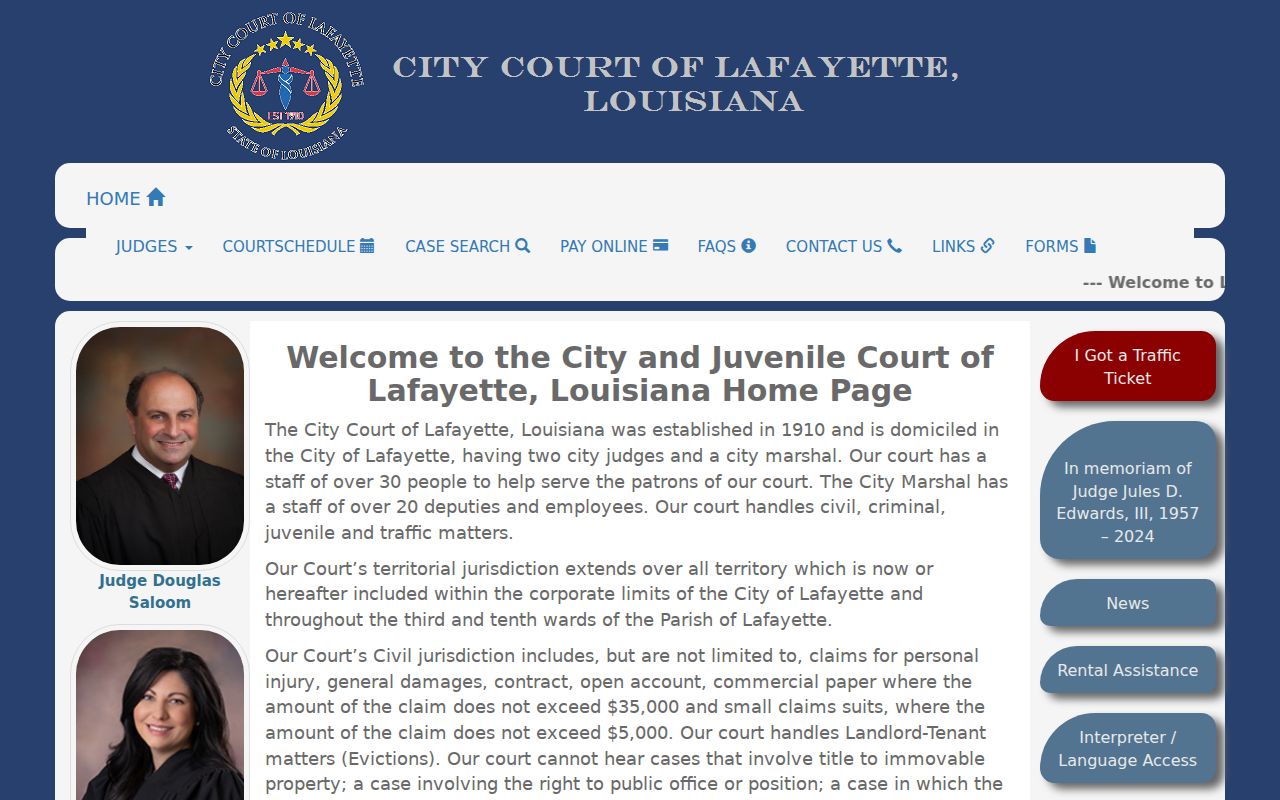
The page carries its own warning. Lafayette Parish data updates roughly every 30 minutes, is not real time, and should never be used to verify warrant status.
What a Lafayette Parish Warrant Search Returns
A result is a case summary, not a warrant document. In Lafayette Parish warrant records, the status and the issuing court decide what happens next, so read those fields first.
| Case or Docket Number | The identifier for the case. A city docket example is XX012345678. |
|---|---|
| Defendant Name and Date of Birth | Shown in city court results, and used to tell two similar names apart. |
| Charge or Violation | The offense, plus any amended violation. |
| Case Status | Whether the case is open, closed, or marked court mandatory. |
| Fine and Bond Amounts | Amount imposed, amount paid, and the bond set, when the case carries one. |
| Court Date Events | Past and upcoming settings, which show whether a date was missed. |
Note: A court-mandatory flag is a scheduling signal, not evidence that a warrant exists.
Lafayette Parish Warrant Search Gaps
A blank result means the record is not in that system, not that no warrant exists. A city court may hold it without ever feeding the sheriff's portal. It may be sealed or juvenile. It may be tied to a pending investigation, or issued after the last data load. The clerk may have filed it while the sheriff's entry is still pending. Missing data is common in Lafayette Parish. Some records omit a date of birth entirely. Those will not match a warrant search that depends on one. The sheriff's own guide warns that some demographic fields are absent during the system transition. Nor does a list speak to a warrant still unserved. The fix is simple. Call the issuing court rather than running another online search.
Where Lafayette Parish Warrants Are Checked
Four layers hold Lafayette Parish warrant information. Each one answers a different question. The sheriff's warrant division confirms parish-level criminal court status and service. The clerk of court holds the filed felony and traffic record. That office also answers record requests. City court and the city marshal confirm city charges, citations, and bench warrants. Mayor's courts and justice-of-the-peace courts keep local matters. Federal process sits outside all of it. The Western District of Louisiana covers Lafayette Parish from the courthouse on Lafayette Street, and the U.S. Marshals office serves federal warrants. A clean local result proves nothing federal. For the published lists behind these records, the active warrant page covers what is public and what is not.
Lafayette Parish Warrant Number Types
Every Lafayette Parish office numbers its own warrant paperwork. Searching with the wrong identifier wastes a call, so know which number your case uses before you pick up the phone.
- Docket number
- A court's own case number. City court dockets follow an XX-prefixed pattern.
- Citation number
- The number printed on a traffic ticket, used for payment searches.
- Booking number
- Assigned at the correctional center when someone is booked.
- Warrant number
- No parish-wide format is published, so the prefix shows which court issued it.
- Cause number
- Another name for a court case number, used in district court records.
Restricted Warrants in Lafayette Parish
Some Lafayette Parish warrant records stay out of public view by law. A restricted warrant is a legal limit, not a missing file.
Key Rules:
La. R.S. 44:3 allows law enforcement to withhold records tied to pending investigations, confidential sources, and security procedures.
Children's Code Art. 412 keeps juvenile court records confidential except as the law allows.
Sealed and unserved warrants stay out of public view, so a search that comes back empty is not proof that no order exists.
Requesting a Lafayette Parish Warrant Record
A written request works when a phone call will not produce a document. Lafayette Parish residents have three accepted ways to send one to the sheriff's records department: in person at 303 West Vermilion Street, by email at recordsrequest@lafayettesheriff.com, or by mail to Captain John Mowell, P.O. Box 3508, Lafayette, LA 70502. Anything sent through an unlisted method is not treated as received. For filed case papers, the clerk of court's criminal and traffic departments are the offices to contact, and they ask for the docket number, the caption, the document title, and the number of copies you need. Keep the ask narrow. Request an existing warrant status, recall, or return record rather than a new investigation. The sheriff's fee schedule covers copies and clearances, though it lists no separate warrant search fee. Before you drive over, the sheriff's records page lays out every accepted request method, the public counter hours, and the fees that apply to Lafayette Parish record requests.

That page also states the counter hours. Reading it first saves a trip to Lafayette Parish.