
The Lafayette Parish Most Wanted Program
A most wanted list is a publicity tool. The agency behind it picks a handful of cases, posts limited details, and asks readers to call in what they know about where a person may be. Rewards and tip routes belong to whichever agency runs the program. In Lafayette Parish, the list a reader is most likely to find is the Marshal's Most Wanted page published by the Lafayette City Marshal. It covers city court matters only. Parish and federal cases sit outside it. That scope matters most. The program is a city one, and it does not speak for the Fifteenth Judicial District Court, the sheriff of Lafayette Parish, or any federal court.
Note: Only the official program page carries current entries, and no names, photographs, or roster entries are reproduced anywhere else.
The Lafayette Marshal's Most Wanted Interface
The marshal's page uses a search-and-card layout. A visitor types into a search box. The page then returns image cards for the current entries. Few official law enforcement sites in Lafayette Parish are built for public viewing this way. Use it as the agency intends. Look for details that identify someone, then call the tip line. It is not a docket or a warrant lookup. Entries change often, so a stale copy can mislead; go to the source itself, since The Marshal's Most Wanted page shows the current listings the city marshal publishes.
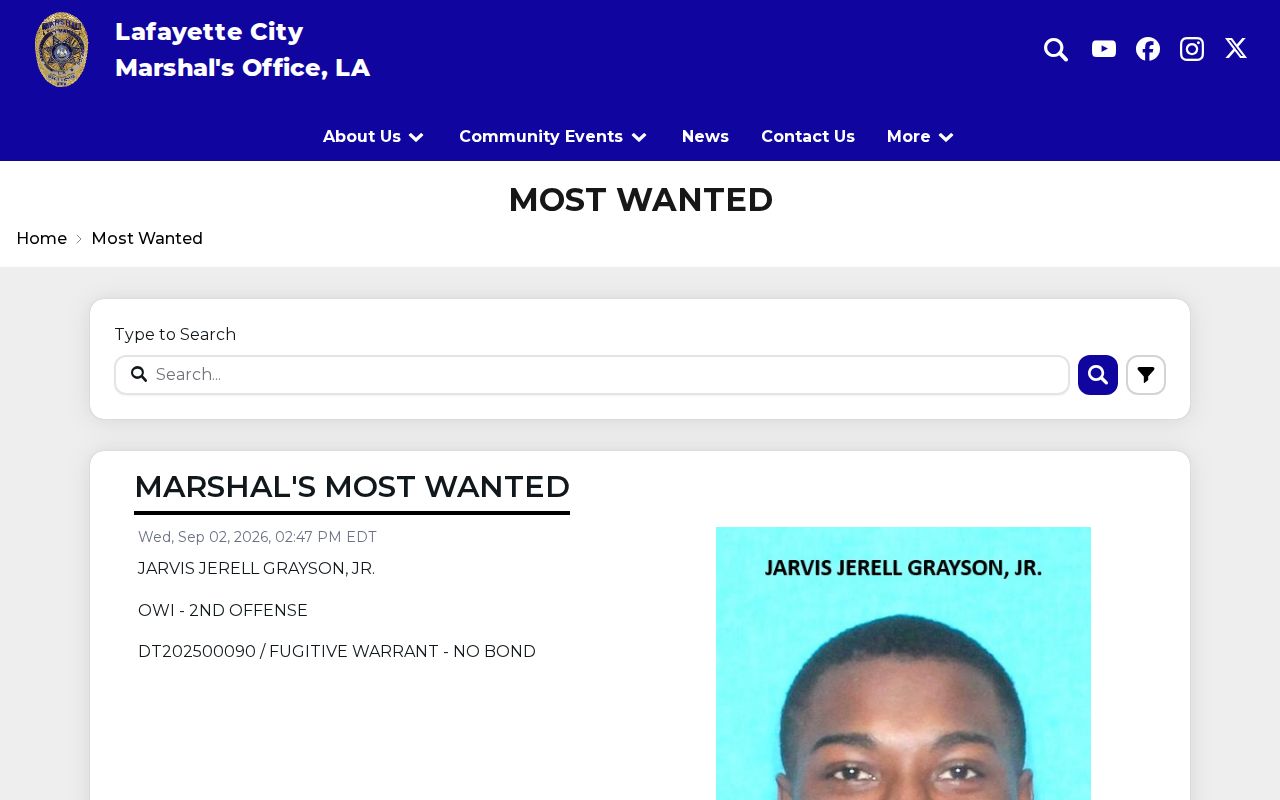
The Lafayette Parish listing appears at the page level only, with no individual entry on display. That matches the limit the office sets.
How the Lists Work
A most wanted list is hand-picked. The sheriff or police department behind it selects a few cases from a much larger pool. Serious charges, public safety worries, and cases where tips could actually help tend to make the cut. A minor unpaid ticket will not land anyone on the list. The lineup shifts over time, too. Entries come off when a person is arrested, when a case resolves, or when the agency simply decides the entry has run its course. No office in Lafayette Parish publishes that cycle on a fixed schedule. A cached copy of the page can sit stale for weeks. So go straight to the official Lafayette Parish page for any warrant check that matters. Only the agency running the program knows which entries are still current.
Lafayette Parish Most Wanted, Arrest Reports, and Active Status
Lafayette Parish produces three different public products that people often mix up. Each one answers a different question.
| Product | What It Shows | What It Cannot Tell You |
|---|---|---|
| Most wanted list | A curated set of cases an agency wants tips on | Whether any other warrant exists |
| Daily arrest report | Recent arrest events and charges | Whether a warrant is still open |
| Active warrant status | The current state of an entry, confirmed by the court or sheriff | Anything about a sealed or federal case |
An arrest alone does not clear an entry. Removal does not dismiss the charge. The Lafayette Parish active warrants page explains how active status is confirmed with the court or sheriff.
How to Report a Tip Safely
A tip works best when it is specific and calm. Say what you saw, when, and where. Lafayette Parish officers act on details, not hunches. Never confront anyone, follow a car, or try to confirm an identity yourself.
Key Rules:
Call 911 for anything happening right now. For information about a past sighting, use the agency's published tip line.
Never send money to anyone who calls about a warrant. The sheriff's office states that it does not seek payment by telephone.
Lafayette Parish Crime Stoppers takes anonymous tips at 337-232-8477, written as 337-232-TIPS. The sheriff's office also posts a general number, 337-232-9211.
Note: A tip line accepts information about a case and does not schedule a surrender, a payment, or a recall.
Why the Lafayette Marshal's Page Says Not to Verify Warrants
Lafayette City Court's public case page carries a blunt warning. The data refreshes about every thirty minutes, so it is not real time. The court says plainly that the page should not be used to verify whether a warrant exists. That warning reaches most wanted programs too. A page built for public tips is not built for record accuracy, and its entries are chosen for publicity rather than completeness. So flip the order many people try. Confirm status with the Lafayette Parish court or the warrant division first. Treat the most wanted page as separate publicity.
Most Wanted vs an Active Warrant
The two ideas overlap without being equal. An active warrant is any open entry in a court or sheriff record for Lafayette Parish. A most wanted list is a hand-picked subset. The agency chose to publicize those entries.
| Point | Most Wanted List | Active Warrant |
|---|---|---|
| Who controls it | The agency running the program | The court that issued the order |
| How many entries | A small curated set | Every open entry in that system |
| What it is for | Gathering public tips | Recording the current status of an order |
| What absence means | Nothing about other cases | A record was not found in that system |
Lafayette Parish Crime Stoppers Tip Line for Most Wanted Cases
Crime Stoppers stands apart from the courts and the sheriff. It takes anonymous information and passes it along. Its tip line is one channel the sheriff's annual reports credit for case activity in Lafayette Parish. The local line is 337-232-TIPS, or 337-232-8477. A caller can share what they know without leaving a name. Reward amounts are set case by case. No fixed schedule is published. Confirm current terms with the program instead of assuming a figure. The local Crime Stoppers tip-line page explains how the anonymous reporting route works across Lafayette Parish.
If You Believe You Are on a List
Seeing your own name on a public program page is stressful. Do not call the tip line. Do not approach anyone connected to the case in Lafayette Parish. Respond carefully, and let a lawyer advise you.
Contact a defense attorney first. An attorney can confirm whether an open warrant exists, contact the issuing court, and arrange a voluntary appearance or surrender where that is possible.
Call the court or the warrant division yourself. Ask about your own case and get the current status in Lafayette Parish. Keep any written confirmation the office hands you. A public listing is not a court record, and only the court can say what is truly open.
Federal Most Wanted Tips in Lafayette Parish
Federal cases move on a track of their own. The U.S. Marshals Service serves federal warrants and runs the Western Louisiana Fugitive Task Force. That task force works with state and local agencies on longer-range cases around Lafayette Parish. It has two phone lines. The 24-hour fugitive tip line is 1-888-869-4589, and the task force line is 318-676-4293. Both take information about federal fugitives, not questions about a state or city warrant. Federal warrants can also be sealed, so a clean result from a parish or city system tells you nothing about them. If you have a question about your own federal case, call the federal court or talk to a lawyer.
What the Lafayette Parish Most Wanted Program Does Not Do
A most wanted program does not clear warrants. It does not confirm them, and it is not a records office. It cannot replace a court call, and it never publishes a complete list of open cases. A listing can come down without a case ending. The programs do one thing well: they get information to the right agency. Everything else about a warrant in Lafayette Parish runs through the court that issued it or the office that would serve it.
Note: An entry can linger after an arrest while the agency updates its page, so a listing is not current status on its own.